
As a followup to the post yesterday about Alexandra Gardens in Kew here is a photograph of the actual plaque in the gardens commemorating the gifting of the Mimovich sculptures to the City of Kew.
It's a lovely day today so I hope some of you find time to visit and spend some time in Alexandra Gardens.
Showing posts with label Kew. Show all posts
Showing posts with label Kew. Show all posts
Thursday, December 29, 2011
#blog12daysxmas Day 5 Mimovich plaque


Wednesday, December 28, 2011
#blog12daysxmas Day 3 Alexandra Gardens

One of the most beautiful places in the City of Boroondara is undoubtedly the Alexandra Gardens in Kew. This oasis of calm and green is situated in Cotham Road between the Kew Library and Gellibrand Street. Visitors to the library can enjoy sitting looking from the western part of the building to these gardens and can wander through them on the way to the junction.

Alexandra Gardens are of historical significance and a "substantially intact park of the Edwardian period and for being one of the few formally landscaped parks in Kew" according to the City of Kew Urban Conservation Study completed in 1988.
Though a band rotunda had been erected locally in 1863 as a memorial of the establishment of the Borough of Kew, the Alexandra Gardens were an Edwardian creation and officially opened to the public on 8 April 1908 by the Governor of Victoria, Sir Reginald Talbot.

The bandstand was erected and opened on 14 December 1910 to mark the Jubilee of the Municipality of Kew and the establishment of the Town of Kew and provided a place for the Kew Band to play a series of moonlight concerts that summer.
The Queen Victoria Jubilee Fountain, formerly situated adjacent to the Kew Post Office in the junction was removed from its original site in 1924 to make way for the war memorial and relocated in the north-west corner of Alexandra Gardens.

Another pleasant feature of the gardens is the installation of sculptures by local artist Leopoldine Mimovich. The ten sculptures were given to the people of Kew "for their enjoyment" by the sculptor and were officially accepted by the Mayor of Kew, Councillor Michael Montalto, on 11 February 1990. Another of her sculptures celebrates the reopening of the Kew Library in its current location.
Saturday, June 25, 2011
#blogjune 24 Kew Urban Conservation Study
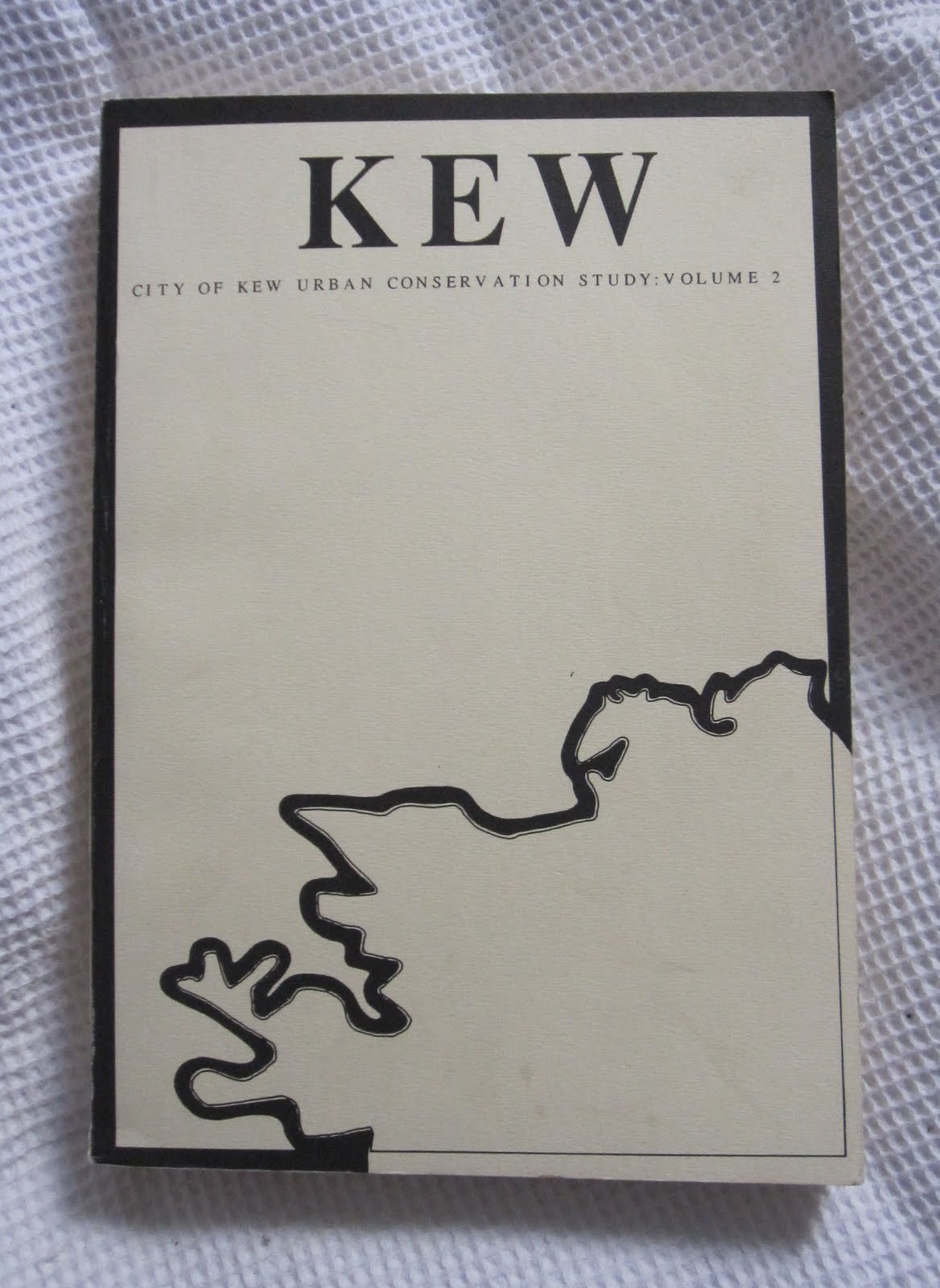
We have lots of fascinating books covering the history of the area in the City of Boroondara Library Service's collections. And sometimes the titles and covers are not very good give-aways of their usefulness.
Take the cover of Kew: City of Kew Urban Conservation Study which was published by the former City of Kew in 1988. Does that give you any idea of the gems inside it? It looks like a standard report with a meandering Yarra going through it. Volume 1 is just that and covers planning controls, methodology, the Burra Charter, etc.
But volume two whose cover is illustrated above is an incredibly useful tool to family and local historians and to library staff. It has a useful 31 page summary of the history of Kew from early days to the late 1970s. Whilst the focus is on planning and development and the built form, it is a very useful tool if someone is looking for a quick context to a property or just wants a quick glimpse into Kew's past. This section also includes a range of maps and subdivision plans from different eras that give a good sense of how the city came to be as it was in 1988 and provides the context for how it has evolved further until today.
The second part of volume two had detailed histories of Grade A properties and limited information on Grade B properties. This includes houses of various eras from the early to mid Victorian up until post World War II as well as churches, memorials and institutions and provides a great tool. The 1988 illustrations are an historical resource in their own right.
The next section covers open spaces and examines formal parklands such as Alexandra Gardens, something defined as Remnants of Former Users which includes the former Outer Circle Railway, Yarra Boulevard, and Flood prone areas such as the two golf clubs and Hay's Paddock. Again each section provides a short history of each site as well as current conditions.
The final section is entitled Building Conservation Guidelines and includes all sort of useful surveys of elements of buildings. So if you want a bit of information about chimneys in the early 20th century, this is a good tool.
Subscribe to:
Posts (Atom)


